| Variable Pitch Tooth and Gullet Depths | |
|
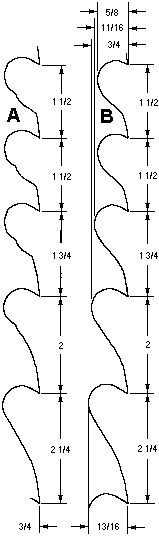
For Band Saws That May Cut Faster and Straighter Without Wash boarding Top illustration (at left): 2-1/4" tooth space is 106% of the 2-1/8" tooth space. These teeth are within the recommended limits. Lower illustration (at left): 2-1/4" tooth space is 120% of the 1-7/8" tooth space. The much shorter second tooth may not be strong enough for the tooth bite required. |

| Variable Pitch
Tooth and Gullet Depths The performance of variable pitch band saws is usually best when, for every three consecutive teeth in the saw, the distance between the first tooth and the second tooth entering the cut does not exceed 115% of the distance between the second and third teeth. Saw filers in the western USA are discovering that band saws with a variable tooth spacing, or pitch, often perform significantly better than conventional, evenly spaced, saw teeth. The two ways to grind these variable pitch saws with an Armstrong sharpener, reviewed below, are with conventional cams or special 5-lobe cams. Why Variable Pitch Improves Saw Performance Unevenly spaced saw teeth eliminate or dampen the harmonic vibration that causes "washboard" in band saws. The advantages of unevenly spaced saw teeth have been well known in the metal cutting industry for many years. In the 1980s, circular rip saws with unevenly spaced teeth were introduced in sawmills with excellent results. Now, American saw
filers are proving the advantages of variable pitch band saw teeth. Feed speeds may be
increased. Washboard is eliminated or significantly dampened. Target sizes and kerfs may
be reduced. Some filers report performance is especially improved sawing frozen
wood, indicating that variable pitch band saws should work well in hardwood sawmills, too.
|
|
||
| Variable Pitch Tooth and Gullet Depths | |||
Sawmillers with Armstrong band saw sharpeners can explore the advantages of band saws with variable pitch teeth now by simply ordering new saws, available from a variety of vendors, and new cams from their local Armstrong Stocking Distributor/Service Center. All genuine Armstrong cams will grind saws with a variable pitch tooth pattern. Most filers report they have the best success with a 5-tooth "segment" of variable pitch teeth. This segment usually has the longest pitch tooth entering the cut first, followed by the second longest tooth, and then the third longest tooth. The two shortest teeth in the segment are exactly the same. Then the 5-tooth segment is repeated. The saw length (or the spacings between the teeth) is adjusted so that the total number of teeth in the saw is evenly divisible by the number of teeth in the segment.
Armstrong has developed a system to grind variable tooth patterns where both the gullet depth and the tooth pitch change. This Variable Pitch and Depth (VPD) system is now available on No. 4 Armstrong sharpeners. Later in 1998, this system will be available for Armstrong No. 6 band saw sharpeners, too.
The special "VPD No. 4 sharpener" uses cams with up to five lobes so each gullet can be sized to match the tooth spacing. These saw teeth will be stronger and easier to maintain. Sawmillers will have the option of:
|
Variable
Pitch and Depth The preceding guidelines will help sawmillers evaluate the advantages of variable pitch saws in their mill. Saw filers will discover additional advantages to grinding variable pitch saws that also have variable gullet depths:
Ordering Variable Pitch Saws and
Cams When ordering cams and saws to test the advantages of variable pitch saws, consider the following guidelines:
|
||